Seq2CareSD
Genomic Insights and Empathy for Inclusive Healthcare
Join the 2027 Seq2CareSD cohort! Building on the success of our inaugural program, Seq2CareSD combines self-paced, asynchronous online learning with an immersive in-person summer experience in San Diego. The 2027 program begins in April and culminates with the in-person workshop in late June. Program participants can opt-in to voluntary, clinical-grade, personal genetic testing; costs will be covered by the program.
Read on to learn more!

Seq2Care employs an innovative experiential learning approach to develop fundamental skills for integrating precision health tools in clinical settings. Students will have the option to participate in a voluntary, no-cost, secure, clinically validated personal genetic testing experience, to learn about their own genetic variants and engage with course content from a patient perspective. Students will receive an equivalent learning experience regardless of whether they opt-in or opt-out of the genetic testing experience. Skills learned in this course provide a baseline foundation for incorporating genomic healthcare into any specialty. Course activities explore the utility of clinical genomics technologies for identifying and managing hereditary health risks. Key issues of ethics, social justice, and health equity provide real-world framing for strategies that can support the inclusive delivery of genomic healthcare. A central focus is on skill-building to support compassionate interaction, interpretation, and communication of genomic information with diverse patients and families.
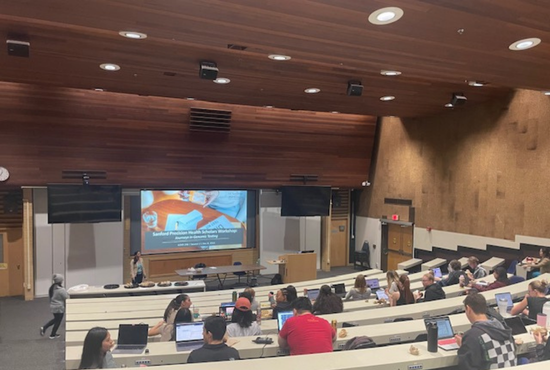
The program will begin with a two hour virtual, synchronous session, followed by eight asynchronous learning modules that students will complete over the course of two months, and then conclude with a 2.5 day onsite in-person workshop at the UC San Diego campus. Convening on campus, students will delve deeper into the principles and core learnings of the course, engage in compassion training, interact with leading experts through guest speaker sessions, and hone skills with peer-to-peer role play scenarios.
This summer program for medical students offers hands-on, immersive training in clinical applications of genetic technologies with an emphasis on:
- Ethics, equity, and empathy in precision health
- Building skills for interpretation and utilization of genetic test results in healthcare practice
- Compassionate communication and discussion of genomic information with patients and families
Program Benefits:
- Experiential learning, with most costs covered: Participants accepted into the program will receive 3 nights of accommodations and meals at UC San Diego during the in-person workshop in July 2026 and a stipend to help offset the cost of traveling to San Diego
- Easily accommodate your schedule: Prior to the in-person workshop in July, students have approximately 3-months to complete the self-paced, asynchronous modules
- Explore your genetic profile: Program participants can opt-in to voluntary, clinical-grade, personal genetic testing; costs will be covered by the program
- Enhance your resume: At the end of the program, participants will receive a Certificate of Completion
- Expand your network: Interface with a cohort of talented medical students from across the nation and leading experts in the fields of genetics, genomics, and precision health
- Emphasize empathy, ethics, and equity in precision health: Through our unique programmatic lens, build clinical skills that support actionable and impactful implementation into patient care
Program Requirements:
- Participants must be currently enrolled in an MD-granting program at an accredited or provisionally-accredited US-based institution. The program is open to all medical students, MS 1-4, though pre-clinical students may be better able to commit to the following program schedule.
- April 2027: Attendance at Virtual Kickoff Session
- Prior to the first virtual session, learners will be assigned one (1) preparatory module with required readings and assignments, and supplemental optional materials. Learners will review these materials prior to the first virtual session and complete the assignment no later than one week following the first (virtual synchronous) session.
- Students will meet each other and the instructors at an opening 2-hour virtual session that will be facilitated synchronously via Zoom. This session will serve to orient students to the program, the learning objectives, the schedule, and the optional personal genetic testing component.
- April - June 2027: Participation in self-paced, asynchronous modules between sessions
-
Eight (8) modules with required readings, assignments, and supplemental materials will be available for students to complete between the initial virtual session and the in-person workshop in San Diego. Suggested pacing will be one (1) module per week. Students may complete the modules at their own pace, as their schedule allows, as long as all modules and required assignments within them are completed prior to convening in San Diego. Module content and topics include:
-
Module 1: Decision-making and Participation in Genetic Testing
-
Module 2: Exploring Consumer Genetic Testing
-
Module 3: Genomics and Health Disparities
-
Module 4: Variant Interpretation
-
Module 5: Hereditary Cancer Case Exercise
-
Module 6: Hereditary Heart Health Case Exercise
-
Module 7: Pharmacogenomics Case Exercise
-
Module 8: Exploring Genetic Counseling
-
-
- June 23 - June 25, 2027: Attendance at in-person summer workshop at UC San Diego
- Following completion of the asynchronous modules, students will convene on-campus at UC San Diego to solidify their learning through a 2.5 day in-person workshop featuring hands-on, collaborative group activities and exercises. Students will have opportunities to engage topics of interest at greater depth through small and large group discussion and individual and collective reflection on their learning experience, with a focus on skill-building to support empathy and compassion in genomics care. Topics include:
- Emerging Developments in Genomics
- Clinical Variant Curation, Classification, & Interpretation
- Collaborations with Patients and Advocacy Groups
- Case-based Role Play Scenarios
- Compassion skill-building exercises
- Following completion of the asynchronous modules, students will convene on-campus at UC San Diego to solidify their learning through a 2.5 day in-person workshop featuring hands-on, collaborative group activities and exercises. Students will have opportunities to engage topics of interest at greater depth through small and large group discussion and individual and collective reflection on their learning experience, with a focus on skill-building to support empathy and compassion in genomics care. Topics include:
- Program Evaluation: Continuous improvement is at the core of our program. Participants will be invited to share their experiences through ongoing evaluation. Each unique perspective is deeply valued, and honest insights directly shape and enrich the learning journey for future cohorts.
Questions?
Reach out to the Seq2CareSD program team at Seq2Care-SD@health.ucsd.eduApply for Seq2CareSD
Applications for the 2027 Seq2CareSD cohort will be accepted October 15 through December 1, 2026.
Our Flagship Seq2Care Program
Seq2Care has been offered as an elective course for UC San Diego Medical and Pharmacy students since 2021. Over 80% of students completing course evaluations report significant improvement in their confidence and ability to integrate genomics into clinical practice and their understanding of the benefits and limitations of genetic testing for health risks.
All programs and initiatives coordinated by the Sanford Institute for Empathy and Compassion's Center for Empathy and Technology are designed and implemented in full compliance with Proposition 209 and the University of California Anti-Discrimination Policy.
In accordance with applicable Federal and State law and University policy, the University of California does not discriminate, or grant preferences, on the basis of race, color, national origin, religion, sex, disability, and/or other protected categories.
More information about Proposition 209 can be found here. More information about the University of California Anti-Discrimination Policy can be found here.