MCP Pediatric MS4 Chief (MCP P-MSC)
UC San Diego School of Medicine
Department of Pediatrics
Position Overview
The Mentor Clinician Program’s Pediatric MS4 Chief (P-MSC) position is a leadership opportunity for fourth-year medical students who demonstrate excellence in Pediatric clinical medicine, teaching/mentorship aptitude, and a commitment to medical education. This role provides hands-on experience in educational leadership and near-peer mentorship while supporting the academic and professional development of junior medical students. Through this position, P-MSCs will develop skills essential for their future careers as residents, clinician educators, and leaders in pediatric medicine.
Key Responsibilities
Core Educational Leadership & Mentorship
P-MSCs serve as a bridge between faculty and medical students, supporting learning activities and academic success. In collaboration with Pediatric Clerkship leadership and the Mentor Clinician Program, P-MSCs help facilitate activities that prepare third-year medical students for the unique aspects of the Pediatric clerkship, including review of commonly encountered pathologies, age-appropriate physical exam maneuvers, and how to navigate the patient-parent-provider dynamic. P-MSCs also provide shelf exam support through supplemental educational materials.
P-MSCs will also serve as near-peer mentors to MS3 during their pediatric core clerkship. P-MSCs host office hours and are available to meet with students 1:1 or in small groups to discuss aspects of the Pediatrics core clerkship and provide guidance for those interested in pursuing a career in Pediatrics. During the spring quarter, P-MSCs support rising MS4s in residency preparation through mock interviews, application guidance, and post-match panels.
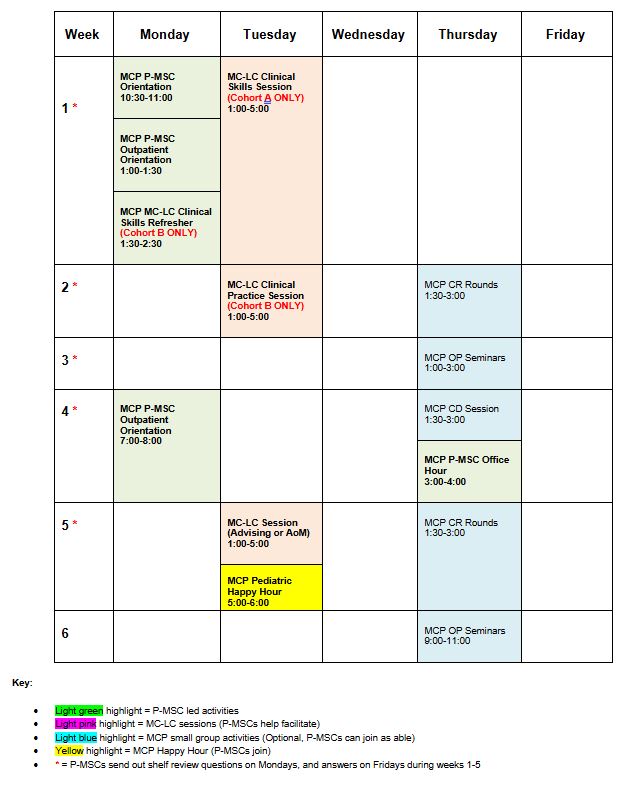
Sample PEDS 401 6-week Clerkship Block Schedule:
Other Teaching/Mentorship Activities:
-
Additional P-MSC Office Hours (recurring, as needed)
-
Intro to Peds preclinical elective course (Fall quarter)
-
Practice of Medicine: Pediatric Practicum (annual, mid-February)
-
MC-LC Spring Advising Sessions (NOTE: advertise P-MSC applications at these sessions)
-
Pediatric Interest Group & Pediatric Subspecialty Interest Groups activities
-
UCSD Department of Pediatrics Pipeline Taskforce meetings
-
“Junior” Mentor Clinician opportunities
Curriculum Development & Quality Improvement
P-MSCs contribute to the evolution of the Pediatric core clerkship curriculum through an independent Chief Project completed during their chief year, either individually or as a team. The overarching goal of these chief-led initiatives is to establish a cycle of continuous quality improvement that enhances the clerkship experience for all medical students. Project examples may include developing new educational materials or updating existing content on the Canvas site, maintaining clerkship success guides, creating comprehensive shelf exam study materials, etc.
-
P-MSCs will submit their Chief Project idea at the beginning of the academic year to Clerkship leadership for approval.
-
The final Chief Project is due in the Spring quarter.
-
Note: if appropriate, the P-MSC Chief Project may be used to meet medical students’ Capstone requirements. This should be discussed with the Concentration Director.
Administrative & Liaison Functions
As key stakeholders in medical education, P-MSCs serve as communication links between various groups within the UCSD School of Medicine. They advocate for student needs while supporting faculty and administrative goals, serving as the primary liaison between medical students, Pediatric faculty, residents, and relevant student organizations, such as the UCSD Pediatric Medical Student Interest Group. P-MSCs collect and synthesize informal student feedback regarding clerkship experiences and educational effectiveness, ensuring continuous improvement in program delivery.
-
Each P-MSC will liaison with the UCSD Pediatric Medical Student Interest Group leadership to help coordinate one event per academic year (total of 3-4 on an ~quarterly basis).
Learning Objectives:
By serving as a P-MSC, students will be able to:
-
Facilitate small group learning and mentorship sessions.
-
Provide effective, constructive feedback to learners in a supportive and professional manner.
-
Demonstrate effective communication skills that foster approachability and learner engagement.
-
Demonstrate leadership skills, including organization, accountability, and professional behavior.
-
Design and complete a medical education project as detailed above.
-
Reflect on personal teaching and mentorship experiences to identify areas for growth as a future educator in Pediatrics.
Training & Support
All incoming P-MSCs participate in an orientation meeting at the start of their tenure, which provides essential skills and knowledge for effective educational leadership. P-MSCs receive ongoing supervision and support from the Pediatric Clerkship Director throughout the academic year, ensuring they have the guidance needed to excel in their role. Outgoing P-MSCs are responsible for onboarding incoming P-MSCs to ensure peer-to-peer mentorship and seamless knowledge transfer between academic years.
Time Commitment
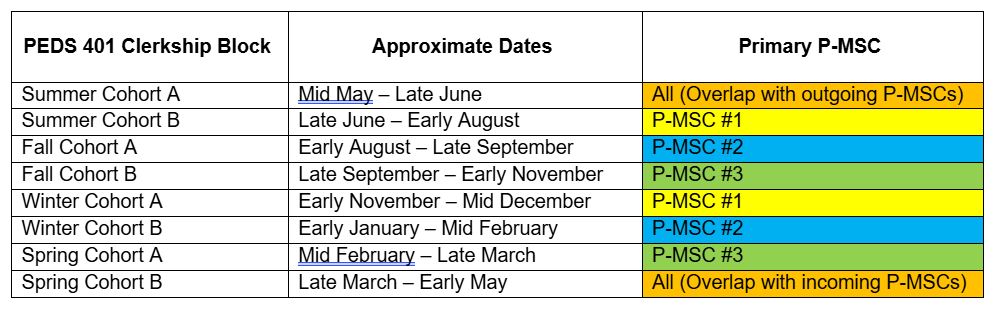
Each P-MSC will be designated as the “Primary MS4 Chief” for a minimum of two 6-week clerkship blocks. During those blocks, the P-MSC will oversee teaching activities for the MS3 cohort rotating on PEDS 401 (see sample table below). If a P-MSC cannot make a given session, they will arrange alternative coverage.
Additional P-MSC responsibilities will be distributed throughout the academic year based on clerkship schedules and educational needs. P-MSCs are also required to attend orientation and training events at the start and end of the academic year.
Sample Primary P-MSC Block Schedule:
Elective Credit
To receive course credit, P-MSCs may enroll in the MCP P-MSC Elective course (or PEDS 496C). Of note, this is a non-clinical elective.
Additional Benefits
-
P-MSC may be listed as a key activity on medical students’ ERAS residency application.
-
The P-MSC role will be included in the Pediatrics Departmental Letter of Recommendation.
-
If appropriate, the P-MSC project may count as the Capstone project requirement.
Application Process
Interested candidates should demonstrate a passion for Pediatric medicine, commitment to medical education, and leadership potential as detailed in previous sections. Students should submit a written application during the spring of their MS3 year, after which applicants may be invited for an interview. A maximum of four P-MSCs will be selected per academic year. All students selected to serve as P-MSCs must fulfill third-year core clerkship requirements, including Pediatrics, prior to beginning their tenure. Specific application deadlines will be determined and communicated by clerkship leadership.
Qualifications & Requirements
Academic Excellence
P-MSCs must be in good academic standing and have demonstrated strong performance in Pediatric rotations and clinical experiences. A commitment to pursuing a career in pediatric medicine and a strong interest in medical education is essential for success in this role.
Leadership & Communication Skills
The position requires proven leadership experience in medical school or professional settings, along with excellent interpersonal and communication abilities. Experience in teaching, tutoring, or mentoring roles is encouraged and will enhance a P-MSCs ability to effectively support junior students.
Professional Attributes
MSC-Ps demonstrate alignment with the UCSD School of Medicine core competencies while possessing strong organizational skills and attention to detail. The ability to work collaboratively with stakeholders including students, faculty, residents, and administrators is crucial, as is a commitment to professionalism and ethical conduct in all interactions.
